
This weekend I was watching some College Gameday on the tube while getting some extra cardio in, and I managed to flip over to a news story about a new computer program created by IBM named “Watson” that is designed to “assist” Physicians in the decision process with patients (more details on the program below).

IBM's Watson computer to assist doctors
The Jeopardy!-playing supercomputer is teaming up with health insurer WellPoint to assist medical professionals in diagnosing and treating patients. Watson, which understands spoken language, played the game show by crunching through multiple algorithms at dizzying speed and attaching a percentage score to what it believed was the correct response. Watson, the television game show-playing supercomputer from IBM, is teaming up with health insurer WellPoint to assist medical professionals in diagnosing and treating patients. IBM and WellPoint says "Watson is expected to serve as a powerful tool in the physician's decision making process." IBM and WellPoint, which has 34 million members, said they will "develop and launch Watson-based solutions to help improve patient care through the delivery of up-to-date, evidence-based health care for millions of Americans."
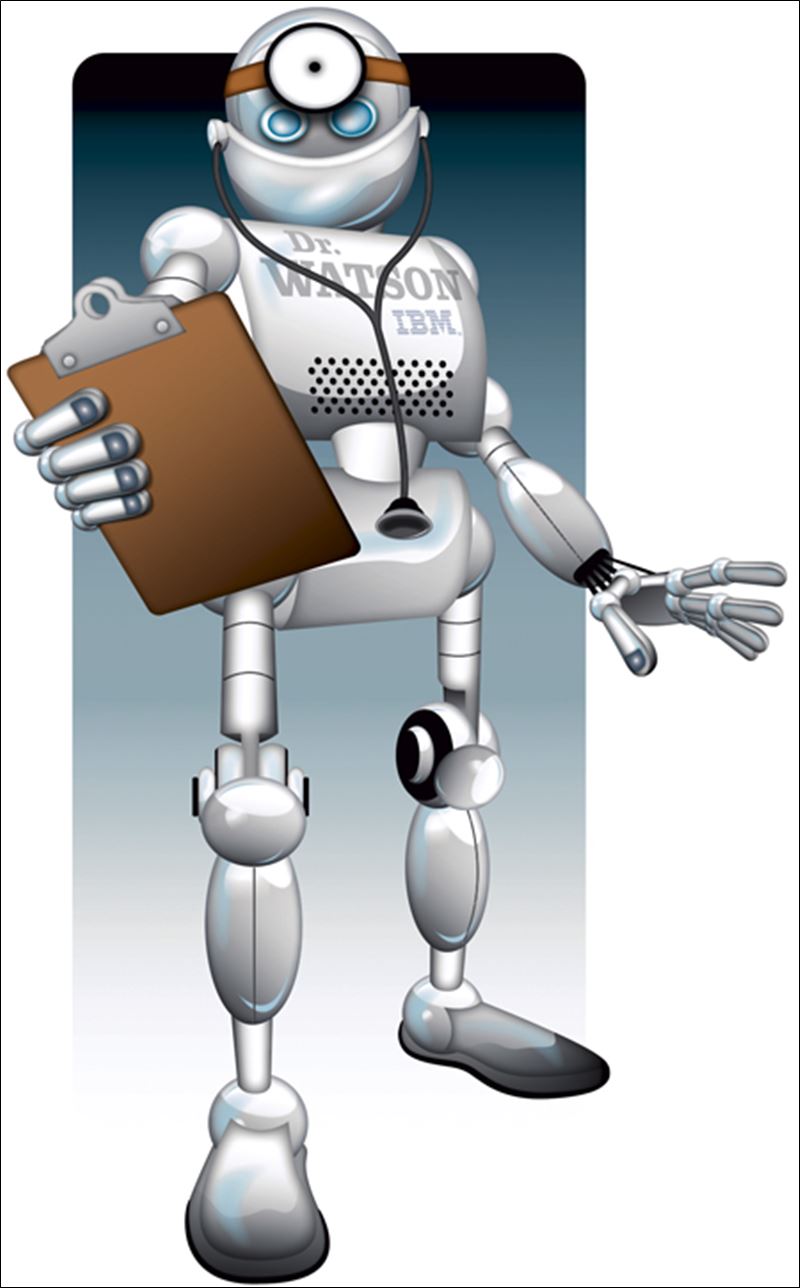
"Using this extraordinary capability WellPoint is expected to enable Watson to allow physicians to easily coordinate medical data programmed into Watson with specified patient factors, to help identify the most likely diagnosis and treatment options in complex cases," IBM and WellPoint said. "We envision that new applications will allow physicians to use Watson to consult patient medical histories, recent test results, recommended treatment protocols and the latest research findings loaded into Watson to discuss the best and most effective courses of treatment with their patients," they said.
WellPoint said it expects to begin employing Watson technology in early 2012 in clinical pilots with selected physician groups.
IBM’s Watson Computer information Copyright 2011 AFP Global Edition
See Full Article Here:
http://www.mnn.com/green-tech/computers/stories/ibms-watson-computer-to-assist-doctors
http://www.mnn.com/green-tech/computers/stories/ibms-watson-computer-to-assist-doctors
This is disturbing to say the least, and even the most mildly interested individual reading this will have at least a few issues with this. So does this now mean that our Physicians and Medical Professionals will now be less involved and therefore not completely liable for their work? This has the potential to start an even scarier domino-effect in the medical field where Doctors no longer bear the weight of information, education, and staying up to date – because after all, it’s not their fault the diagnosis was wrong because Watson told them to.
A technology revolution is fast replacing human beings with machines in virtually every sector and industry in the global economy. Already, millions of workers have been permanently eliminated from the economic process, and whole work categories and job assignments have shrunk, been restructured, or disappeared. Global unemployment has now reached its highest level since the great depression of the 1930s. More than 800 million human beings are now unemployed or underemployed in the world. In all three key employment sectors - agriculture, manufacturing, and services, machines are quickly replacing human labor and promise an economy of near automated production by the mid-decades of the twenty-first century.
There is no single industry or job that is safe from this where technology in some form or fashion, aims to take over and replace them. Being a Fitness Professional, naturally I note the technology forms that invade “my space” or my field of expertise. Technological solutions to traditional personal training have been around now almost a decade now. The range has included everything from completely automated online personal training, to fitness equipment that attempts to make personal training more affordable and available to larger groups of clients. Most attempts have failed - some enormously, after large investments in web infrastructure and product development proved less than effective at replacing personal trainers. There were a variety of reasons for these failures, but the bottom line is that they did not prove to be an effective behavioral change agent.
Let me state very clearly that technology and automation will never replace the value that a skilled personal trainer brings to their clients and likewise, will never replace an educated and experienced Doctor sitting in the patient room listening to your symptoms and using human reasoning and judgment to determine the best next steps. Let it be said though that technology can, however, serve as a great addition to everyone’s profession if we learn more about these new systems and limit their scope of importance.
An article I read in Forbes a few months back stated “your computer will steal your job, sell your house, and send you the bill.” Automation in the 19th century was the disruptive equivalent of high-speed digital technology today, which is replacing jobs in the manufacturing and service sectors at shocking speeds. Self-checkout counters at the grocery store, complete with laser scanners to read bar codes, are starting to replace human cashiers. On the road, the arrival of EZPass and other computerized toll machines are replacing human tollbooth collectors. Electronic passes are cheaper, more efficient and keep traffic flowing at faster speeds. It's only a matter of time before EZPass, or a similar system, finds its way into every car.
So the question arises in everyone’s mind after considering the above: “What jobs are secure from the onslaught of automation?” That same Forbes article I referenced above states "those that involve transferring knowledge from one area to another, or thinking broadly, creatively and integratively, because these [tasks] require powerful general intelligence, not just narrowly specialized intelligence." It’s no wonder skilled engineers are the most sought after workers in today's lousy employment market!
- If you have a horrible day at work and can’t wait to get to your personal training session to ‘vent’ about it to your trainer while getting some great advice while exercising, you’re S.O.L. when it comes to talking to a computer program and venting.
- If you’re feeling really tight in your back and legs from your last workout and need some relief, the computer screen training isn’t going to have you lay down and do some trainer-assisted PNF stretching.
- If you’re in the middle of an exercise and notice an odd pain or feeling, telling the machine won’t help you determine the cause and appropriate next step – only a human personal trainer will.
- If you are having troubles with motivation and decide not to come in to train today, the computer isn’t going to call/email you and convince you to come in. It’s also not going to chat with you and determine these motivation issues and rejuvenate the fire that feeds your fitness training.
Any Personal Trainer or even client/member of our fitness family can tell you that the list can go on and on about the millions of things technology simply cannot replace that a living, breathing Fitness Professional can do for you. The same can be said about many professions, but technology in terms of Computers Vs. Fitness Professionals is where our comparison obviously reads.
End of this Rant & Rave:
Obviously as we stated above there are going to be varying opinions on technology taking over and it’s impact on human jobs being lost. So we want to know what you think! Agree, disagree, add to the above or whatever else comes to your mind. This is a topic that is sure to increase in the coming years as technology continues to increase in its journey to run your lives for you. So we want to hear what you have to say. You can comment to this post or simply reply to our social feeds via our Facebook or Twitter pages.
Until next time!
Keep it fit,
Fitness Mastermind, LLC


This is definitely a nice post. Great works. Thanks for sharing with all of us.Keep posting more.
ReplyDeleteIt really helps me. I'll follow you regularly. Thanks
If anyone is Looking for a international Engineering Jobs specially Nigerian citizens must check this site Oil & Gas Recruitment opportunity