

Believe it or not, this is a “top 10” of the questions we get asked the most by both beginning exercisers & seasoned fit-goers, “what is a side-stitch?” Just in the past couple of weeks I had one myself when running the trails at Champion Park at Brushy Creek, had my wife get one herself at Boot Camp the following day, and just this morning had a new personal training client of mine ask me about it as she apparently got one when doing her off-day cardio yesterday. Because of the recent increase or possibly just my new-found noticing of this, I figured there are likely many more of you wondering the same thing about side-stitches, how they happen, how to prevent them & what to do in order to rid of these pesky little buggers!
So what exactly is that sharp wrench of pain just below the rib cage usually on the right? It is called a "side stitch" or to most Fit Pros it’s known as "exercise-related transient abdominal pain" (ETAP). It’s commonly believed that the repeated stretching leads to spasms in the diaphragm and this spasm causes your pain, a much better than one of my old coach's explanations "because you’re not in-season shape wuss!" Other less accepted theories have included: diaphragmatic ischemia, imbalances of the thoracic spine, and irritation of the parietal peritoneum. Regardless of the proposed cause, there has only been a few of the theories that have been proven via science & research over the past years, and they’ve also produced some very simple tips that should help avoid or at least diminish this pain in most/all cases.

Most textbook definitions & online resources will give you the same definition of a side stitch, with different wording of course, similar to: “a side stitch is a quick, powerful pain under the lower-edge of the ribcage, caused by a muscle spasm of the diaphragm.”
A side-stitch typically comes along during somewhat vigorous exercise(cross-training & running, & according to most research I’ve personally read, occurs more frequently in “beginner” exercisers who have not yet recognized & developed proper training rate(s) & who have a tendency to breathe more quickly & shallow. But on the contrary, it is also well recognized that even about 30-35% of the most seasoned of runners & athletes will experience side-stitches at some point.
Why? Consider the breakdown of a breathing cycle:
· On inhalation, we take air into the lungs, pressing the diaphragm downward.
· When we exhale, the diaphragm moves up.
· If the body has some trapped air/gas below the diaphragm, if we've eaten too close to exercise, or if we start exercising too vigorously, the diaphragm may cramp, causing pain under the rib cage on the right side.
Make sense? Essentially a few of the researchers who have studied the problem have proposed an alternate reasoning in that the pain originates from muscles or ligaments somewhere in the region of the abdomen. However, most agree that the pain is caused by a muscle spasm of the diaphragm, but could also be cramping or straining of the ligaments in the diaphragm/liver area (the liver is the largest and heaviest organ).
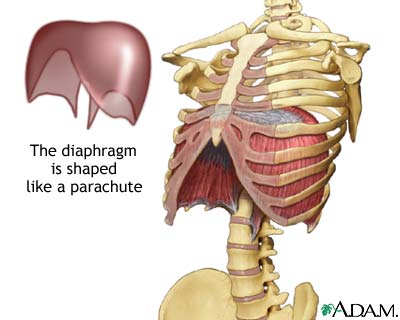
It is safe to say that the pain of a side stitch is not restricted to the diaphragm, but involves a variety of muscles or ligaments in that area. In any case, the pain of it is almost always related to the breathing process. In fact, it usually happens only when we are breathing hard for an extended period of time. The diaphragm & other stomach muscles participate in the breathing process. They move every time we breathe in or out. When we inhale, we move air into the lungs, expanding them. This forces the diaphragm and other muscles down. When we exhale, we expel the air and as the lungs shrink these muscles move back up. Basically the rapid moving up and down can eventually cause a spasm of the diaphragm or other related muscles or ligaments.
Considering the variables involved & possible culprits for this nagging side stitch, it makes you consider several factors:
Considering the variables involved & possible culprits for this nagging side stitch, it makes you consider several factors:
For Example:
· A side stitch could be related to the strength of the related muscles, and how much bouncing occurs in there during running.
o Specifically the combination of weaker stomach muscles and excessive bouncing during running could aggravate the condition, making a side stitch more likely.
o And, if the stitch occurs because of the movement of the internal organs as they bounce up and down while running, then we may be able to help get rid of them by getting our stomachs in better shape.
· Issue #2: the side of our internal organs
o The side stitch could be aggravated by the size and weight of the internal organs involved.
o This means, for example, that a full stomach could be putting excess stress on the related muscles and ligaments.
§ Making sure the stomach is as empty as possible before running might help some runners.
§ But a large organ such as the liver is going to be forced up and down during running, and there is not much we can do about that.
o In the end, the trick is to watch for the first signs of a side stitch and learn how to quickly get rid of it.
So how do you cure a side-stitch when it happens?
Just like with any muscle cramp, the best immediate management is to try to stretch the cramping muscle as much as possible. How do you get to the diaphragm on the inside of your body? Try altering your breathing pattern. Take a deep breath in as quickly as you can, to force the diaphragm down. Hold the breath for a couple of seconds and then forcibly exhale through pursed lips to restrict the outward air flow. You may also find that bending forward can help you expel as much air as possible. Continue running after the stitch goes away. If you get a cramp in the middle of a race, you might want to try mixing up your rhythmic breathing/ striding pattern. If you always exhale when your right foot strikes the ground, try exhaling with the left foot strike.
Can you prevent yourself from getting a side stitch?

Yes and no. The most effective way to prevent a side stitch is to take deep, full "tummy breaths" while running. This allows your diaphragm to entirely lower and reduces the stress on it. If your continuously breathing shallow breaths when running, the diaphragm remains in a consistently high location and never lowers enough to allow the connective ligaments of the liver to relax. The diaphragm becomes stressed and a “side stitch" has a higher possibility of happening as a result.
In essence, to prevent stitches is to make sure you include a warm-up that allows you to gradually increase your running speed over time. If you take off at full running speed from the minute you step out of the truck, you're more likely to take quick, short, shallow breaths, producing a cramp.
10 Quick Fit Tips To Help Alleviate/Avoid Pain From A Side-Stitch:
1. Improve your cardiovascular fitness
2. Warm up properly & fundamentally if needed, before you run
3. Strengthen your core muscles
4. Avoid too much, too soon, too fast syndrome (done most often when training without proper guidance on intensity, pace, etc.)
5. Avoid eating 1-1.5 hours before a workout. Having too much food in your stomach during training may increase cramping by creating more force on the ligaments.
6. Stretching may relieve and even prevent a cramp
a. Raise your right arm straight up and lean toward the left
b. Hold for 30 seconds, release and relax, and then stretch the other side
7. Slow down your pace until pain lessens, or “walk it out”
8. Breathe deeper to stretch the diaphragm when you feel a cramp coming on
a. Then breathe slowly out of your mouth with pursed lips
b. Intended to relax your diaphragm
9. Drink before training(no, not alcohol)
a. Dehydration can increase muscle cramps
b. An electrolyte sports drink may be even more helpful than just plain water, just be leery of sports drinks with TOO MUCH sugar & carbohydrates, in relation to your nutrition too of course.
c. Finding the appropriate balance of just enough sugars/carbs in your sports drink, without putting you overboard on your nutrition log is the key
d. Avoid any carbonated beverages 1-2 hours before training
10. Massage or put firm pressure on the area with pain
a. Bend forward to stretch the diaphragm & ease the pain
If you continue to experience pain most definitely seek medical attention & call your Doctor! A side stitch that lasts more than a handful of minutes could be early signs of appendicitis. Pain searing into your shoulder, chest or back might even be heart-related. For most fit-goers & runners, a side-stitch is just a signal to slow it down a tid bit and chill out. What you don’t want to do is build a habit of the minute you get a slight cramp or even a stitch, pack it up & head home thus ending your training/run. Don’t make excuses, make reasons and make solutions, thus making progress.
On a side-note, be sure to follow what we've described above & "chill-out" & stretch a bit (after a proper warm-up of course) when you get a side-stitch. You don't want to end up having an "exercise fail" like the girl in this video:
(click play to watch, it's hilarious & only a few seconds long)
If you have additional questions we haven’t covered above concerning a “side stitch,” or any other health, fitness and/or nutrition-related topic or issue-let us know! We’re here to help, and whether you’re a client of Fitness Mastermind or not-simply by reading our blogs and staying in touch, you’re still considered a member of our fitness family to us! We love your questions & feedback, so give us a ring or shoot us an email & let us know how we can help!
Until Next Time!
Keep it fit,
Fitness Mastermind, LLC


No comments:
Post a Comment